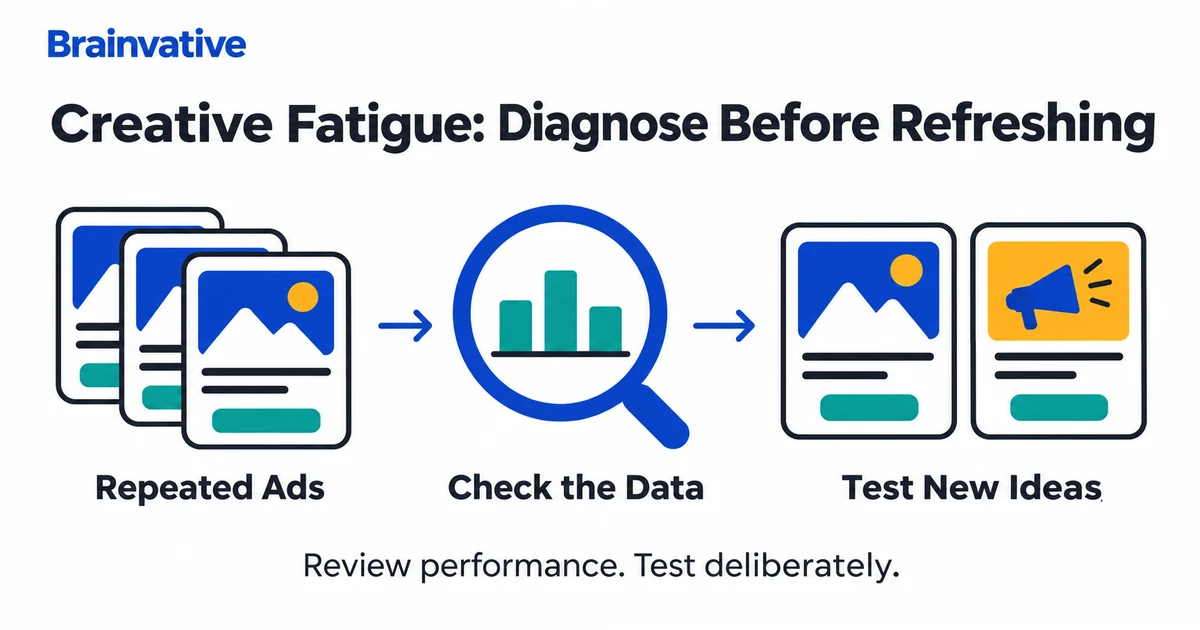

An advertisement that worked last month can become less effective. Repeated exposure to the same message may be part of the problem, but a lower return on ad spend does not, by itself, prove creative fatigue. Tracking changes, an expired offer, unavailable products or a different audience mix can produce a similar result.
The useful response is to locate the change before replacing the ad. This guide focuses on diagnosing the problem, designing a meaningful creative test and judging results against business outcomes rather than a universal refresh schedule.
What is creative fatigue?
Creative fatigue describes declining response to an ad as its message becomes familiar to the audience seeing it. It is a working diagnosis, not a rule that every ad stops performing after a particular number of days.
An ad's age alone does not establish fatigue. A long-running ad may still reach new people or remain useful to buyers. A new ad can fail because the offer or message is unclear. Similarly, a campaign's average frequency does not reveal how often every individual saw each creative.
Look for a combination of evidence: repeated exposure, weaker response to a particular message and deteriorating business results under reasonably comparable conditions. Even then, test the explanation rather than presenting it as a certainty.
Check the measurement before changing the creative
Compare the same metric definitions, attribution settings and reporting periods. Avoid comparing an incomplete day with a completed week or treating clicks on an ad as equivalent to visits that loaded the destination.
For Google Ads, conversion lag reporting explains why recent conversions may not yet be fully reflected, making CPA appear higher or ROAS lower. Consider your conversion cycle before declaring the newest period a failure.
- Check whether conversion events still fire and values use the correct currency.
- Review changes to consent settings, checkout, forms or analytics.
- Compare platform results with received enquiries or recorded orders.
- Record budget, targeting, bidding and offer changes during the comparison.
Google's performance troubleshooting guidance identifies multiple possible causes, including tracking, account settings and auction dynamics. Do not apply a single explanation to every platform and campaign type.
Read the signals together
Frequency rises and response weakens
This can justify testing a different concept, especially if the audience, offer and destination have remained similar. It is not proof that a particular frequency is universally too high. Record the date range and reporting level: an ad-level number is not interchangeable with an account-level one.
Clicks remain steady but purchases fall
Inspect the destination and offer before assuming people are tired of the ad. Check stock, product variations, shipping charges, delivery dates, payment errors and whether the landing page still matches the advertisement. Our landing page guide explains how to review that journey.
CPM rises while response rates are similar
Review changes in delivery, competition, placements and audience settings. An increase in cost per thousand impressions is not evidence of an automatic creative-fatigue penalty.
Lead volume looks healthy but quality falls
Review the promise made by the ad, qualification questions and service eligibility. Count qualified opportunities separately from form submissions. A cheaper lead can still be a poor business result if the person cannot use the service.
These are investigation paths, not a formula for identifying the cause from a single dashboard column.
Build a useful comparison view
For each creative, record its concept, format, first delivery date, offer and destination. Add spend, impressions, reach where available, frequency, the relevant click metric and the campaign's primary result. For purchase campaigns, include conversion value and ROAS; for lead campaigns, include downstream qualification where available.
Use consistent definitions and enough observations to make the comparison meaningful. A creative with one sale and very little spend should not automatically replace an established ad. Keep a change log so a new audience or price change is not mistaken for a creative effect.
Refresh the idea, not just the background colour
Meta's creative diversification training distinguishes variation by concept and format. Use that distinction to plan genuinely different reasons to consider the product.
For example, a luggage business could test a packing demonstration against an explanation of size and storage options. These are illustrative concepts, not client results. Changing only the border colour would not explore the same difference in buying motivation.
- Demonstration: show the product doing the job advertised.
- Objection: address a real question about suitability or use.
- Explanation: clarify what the package includes and excludes.
- Evidence: use a genuine, permissioned customer experience without inventing a result.
Adapt the asset to its placement and check crops, captions and readability. Do not publish unsupported urgency, fake testimonials or a misleading comparison simply to make a new hook more dramatic.
Design a test that can answer a question
Meta's creative testing course covers measuring creative effectiveness. Treat testing as a planned comparison, not a promise that every new variation will win.
- State the hypothesis: explain what you think the new concept will improve.
- Choose the primary measure: use the business outcome appropriate to the campaign.
- Keep the comparison interpretable: avoid simultaneously changing the creative, offer, destination and audience when trying to isolate creative impact.
- Set an affordable budget and review point: account for expected result volume and conversion delay.
- Record the decision: retain, revise or stop the test, with the evidence behind it.
Where an appropriate platform experiment is available, use it to support a controlled comparison. Ads receiving different delivery in an ordinary campaign are not automatically a randomised A/B test. Describe an inconclusive result honestly rather than declaring a winner from too little data.
For campaign planning beyond creative, see Successful Meta Ads Campaigns.
Do not confuse ROAS with profit
ROAS is attributed revenue divided by ad spend. Illustrative example: Rs. 60,000 in attributed revenue from Rs. 20,000 of spend gives a ROAS of 3. It does not establish profit: product costs, discounts, fulfilment, cancellations and returns still matter.
A stronger hook could produce more clicks without improving completed sales. A higher-value order could raise reported ROAS even when the ad's response rate is unchanged. Review the underlying data before attributing the result to creative alone, and do not add platform-attributed revenue totals that may include the same orders.
How often should you replace ads?
There is no single replacement timetable suitable for every audience, budget and purchase cycle. Keep approved alternatives ready, but use evidence to decide when to introduce them. Refresh an outdated price or unavailable product immediately; investigate a performance decline before replacing every working ad.
Maintain an asset library with the concept, permissions, product version and test outcome. This makes the next test easier without requiring an arbitrary number of new ads each month. For clothing campaigns, our ethnic wear creative guide connects creative decisions with stock and delivery constraints.
A practical next step
Choose one campaign with declining results. Validate its measurement, inspect the destination, review changes in delivery and write a specific creative hypothesis. Test a meaningful alternative and assess the business outcome. That process is more useful than treating every drop as boredom or promising that frequent refreshes will stabilise ROAS.
For help coordinating creative planning, testing and reporting, explore Brainvative's social media marketing services.